

Choosing the right kitchen cabinets and finishes is the single most important decision you will make during a kitchen renovation Cambridge homeowners plan. Cabinets account for 35 to 45 percent of the total renovation budget, they define how your kitchen functions every single day, and they set the visual tone for every other material you select. Get this decision right and everything else falls into place. Get it wrong and no amount of beautiful countertops or designer lighting will save you.
This guide walks you through every layer of the decision, from the inside of the cabinet box outward, so you end up with a kitchen that works brilliantly for years, not just looks good in the showroom.
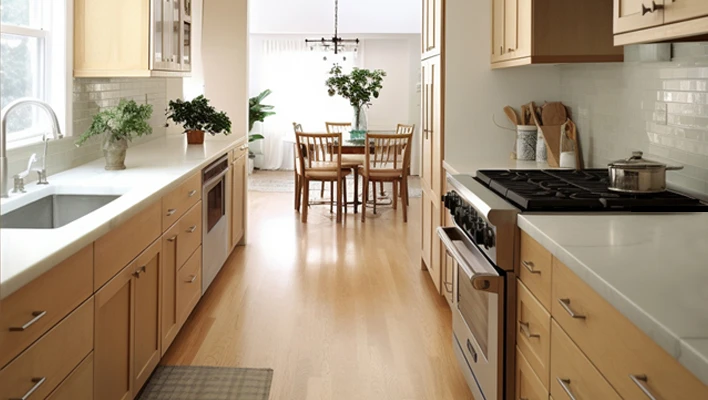
Start With the Cabinet Box, Not the Door
Most Cambridge homeowners walk into a showroom and go straight to the door styles. This is one of the most common and costly mistakes in any kitchen renovation. The door is the face of the cabinet. The box is the structure that determines whether your investment lasts 10 years or 25 years.
The cabinet box needs to handle daily humidity from cooking, steam from the kettle, cleaning products wiped across surfaces, and the mechanical stress of opening and closing thousands of times. Two cabinet options that look identical on a showroom floor can perform completely differently once they are installed in a working kitchen.
Plywood boxes are the preferred choice for durability. Plywood holds screws better, resists moisture more effectively, and does not break down the way cheaper materials do. If a supplier cannot confirm plywood box construction, that is information worth taking seriously before you sign anything.
MDF (medium density fibreboard) is commonly used for door panels, particularly in painted finishes, because it provides a smooth and consistent surface. MDF doors paired with plywood box construction is a strong combination that balances cost and performance well for most Cambridge homeowners.
Particleboard boxes are found in budget ranges. They are not inherently a deal-breaker at lower price points, but edge quality, laminate bonding, and hardware specification matter more when the core material is less robust.
The bottom line on box construction is this: spend your money on the parts you cannot see before you spend it on the parts you can.
The Three Cabinet Tiers: Stock, Semi-Custom, and Custom
Understanding where you sit on this spectrum before you start shopping saves a significant amount of time and prevents scope-creep surprises.
Stock cabinets are manufactured in standard dimensions, typically in 3-inch width increments, and are available from home improvement retailers with little or no lead time. They are the most affordable entry point. The limitation is fixed sizing, which often requires filler strips to address gaps, and limited finish and interior configuration options. For a straightforward kitchen layout in a newer Cambridge build, stock cabinets can deliver good value if hardware and installation quality are solid.
Semi-custom cabinets allow dimension modifications and a broader range of finishes and door styles. Lead times typically run four to eight weeks. This tier suits most Cambridge kitchen renovations because it balances design flexibility with a manageable budget, and most Cambridge homes have dimensions that respond well to the sizing increments semi-custom manufacturers offer.
Full custom cabinetry is built from scratch to exact specifications. There are no size compromises, no catalogue restrictions, and no limitations on finish, interior configuration, or material. Custom is the right answer for older Cambridge homes in Galt and Preston with non-standard kitchen dimensions, heritage properties with unusual ceiling heights or irregular wall angles, or any homeowner who wants a furniture-grade kitchen that functions as a bespoke piece rather than an installed product.
Cabinet Door Styles: What Holds Up and What Dates Quickly
Door style is where the style conversation happens, but it is also where some homeowners overspend relative to the value it delivers. Here is an honest breakdown of the most common options for Cambridge kitchens.
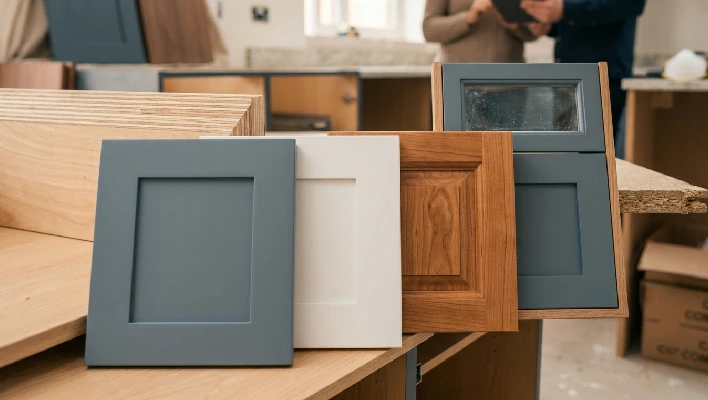
Shaker doors are the benchmark choice for a reason. The recessed panel design is clean, adaptable, and works as comfortably in a 1960s Galt bungalow as in a new detached home in North Galt. Shaker translates across modern, transitional, and traditional kitchens without becoming a liability when tastes shift. If resale value matters to you, shaker is the safe and commercially strong choice.
Slab or flat-panel doors offer a contemporary and minimal look with no frame detailing. They suit frameless cabinet construction and pair well with integrated handles or push-to-open hardware. The tradeoff is that flat-panel doors have nowhere to hide imperfections in finish or installation, so quality of the paint or lacquer system matters considerably more. They also carry slightly more design-trend risk over a ten or fifteen year period.
Raised-panel doors are traditional in profile and suit heritage-style Cambridge homes well, particularly in Galt where older architectural character is prominent. They require a little more effort to clean around the profile details but many homeowners find the visual depth worth it.
Inset doors sit flush within the cabinet frame rather than overlaying it. This delivers a refined, furniture-quality look that is the most expensive option to produce well. Inset cabinetry suits formal kitchen designs and is increasingly requested in higher-budget Cambridge renovations.
Glass-front upper cabinets work beautifully as accent pieces, breaking up solid door runs and adding visual depth. They are most effective used selectively on upper sections rather than across an entire kitchen.
Finishes: The Decision That Affects Daily Life More Than Any Other
The finish is what you clean, what you see under different lighting conditions throughout the day, and what absorbs the physical reality of a working kitchen. Choosing a finish purely for its showroom appearance without accounting for how it performs is one of the most reliable sources of renovation regret.
Painted finishes are the most popular choice across Cambridge kitchens. The key variable is the coating system used, not just the colour. A factory-applied catalyzed conversion varnish is meaningfully more durable than a standard lacquer. It resists chipping at edges, cleans more reliably, and holds colour better over time. Ask specifically about the coating system before selecting a painted finish. Semi-gloss and satin sheens are better practical choices for kitchen cabinetry than matte because they clean without leaving visible marks.
White painted cabinets look exceptional on day one. By year three in an actively used kitchen, the story around handles, near the oven, and at drawer corners tells a different tale. If you are committed to white, choose a semi-gloss factory finish and pair it with handle or hardware placement that minimises the contact points on the painted surface itself.
Stained wood finishes age more gracefully than painted cabinets in terms of daily wear because grain variation and minor marks absorb visually rather than standing out. They do require consistent humidity management, which matters in Cambridge’s climate across winter and summer extremes. Maintaining indoor relative humidity between 35 and 50 percent protects wood cabinet construction from seasonal expansion and contraction.
Wood tones and natural finishes are the strongest trend in Canadian kitchens heading through 2026. White oak leads current demand among design professionals and homeowners across Ontario, followed by walnut. According to the NKBA 2026 report, wood-toned finishes have overtaken white as the most installed cabinet finish in Canada for the first time in nearly a decade. For Cambridge homeowners planning a renovation now, natural wood finishes represent both current relevance and long-term staying power.
Thermally fused laminate (TFL) panels with textured wood-grain surfaces deliver strong durability and consistency at a lower price point than real wood veneer. The best current products use synchronized embossed technology that matches the visual grain to a tactile texture, making them difficult to distinguish from natural wood in person. TFL is an excellent option for Cambridge homeowners who want the warmth of wood with stronger resistance to daily wear.
Thermofoil wraps are common in budget installations. They can perform well when quality is specified carefully, but edge bonding near heat sources deserves attention. Thermofoil near dishwashers, ovens, and kettles is vulnerable to heat-related lifting if installation quality is not high.
Two-tone cabinet schemes have moved from trend to established practice in Ontario kitchens. A lighter colour on uppers paired with a contrasting island or base colour adds visual interest without overcommitting to a bold choice across the entire kitchen. This approach suits many Cambridge homes well, particularly where the kitchen is visible from an adjacent dining or living area.
Colour: What Works in Cambridge Kitchens Right Now
The shift away from all-white kitchens that defined the previous decade is well established. Cambridge homeowners renovating now are choosing from a broader palette with more intention.
Warm neutrals including mushroom, greige, taupe, putty, and clay have replaced stark white as the dominant choice. These colours carry a warmth that reads well under both natural and artificial light, and they hide fingerprints and minor marks more forgivingly than pure white.
Green, in particular sage, eucalyptus, forest, and olive tones, is the colour that has made the most significant move in Canadian kitchen design. Lighter greens suit kitchens with good natural light. Darker greens are best used on lower cabinets, islands, or feature sections where they do not enclose the space.
Deep navy and charcoal continue to perform well on islands and base cabinets, particularly where the upper cabinets remain lighter. Natural wood tones work alongside both neutral and deep painted colours without conflict.
For Cambridge homes where the kitchen has limited natural light, choosing a lighter upper cabinet colour and reserving deeper tones for lowers or the island keeps the room feeling open while still delivering visual character.
Hardware: The Detail That Changes How Your Kitchen Feels Every Day
Hardware is often treated as a finishing decision, something to sort out at the end of the renovation. In practice, it is one of the few choices that affects your experience of the kitchen multiple times every single day.
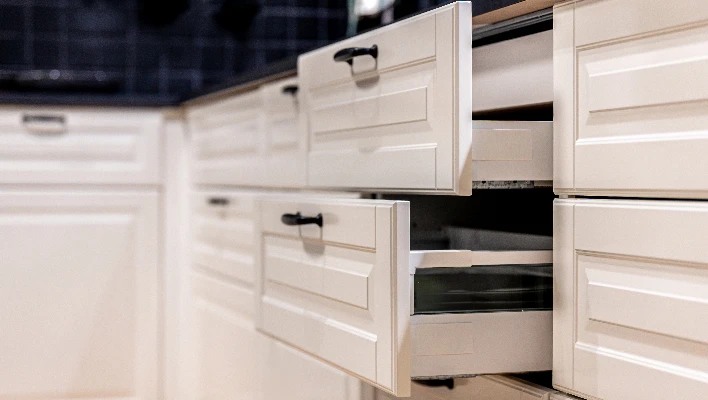
Soft-close hinges and full-extension drawer slides are no longer premium upgrades in a well-specified kitchen renovation. They are baseline expectations. Soft-close hardware protects the cabinet box from repeated impact, keeps doors and drawers aligned over time, and changes the day-to-day feel of the kitchen in a way that is immediately noticeable. The brands that design professionals consistently specify include Blum, Hettich, and Salice. These names are worth asking about specifically.
Pull-out drawer base cabinets deserve a special mention. Traditional base cabinets with a door and interior shelves are a functional compromise. The back corners collect items that never get used, and the everyday experience of accessing pots, pans, and stored goods from a crouch is genuinely inconvenient. Full-height drawer base cabinets address this directly. Every homeowner who makes this switch consistently reports the same thing: they wish they had done it sooner.
Hardware styles in 2026 favour brushed brass, matte black, champagne gold, and minimalist bar pulls. Brushed and satin finishes in all metals hold up better to everyday handling than polished equivalents and do not show fingerprints. Mixing two metal tones within a kitchen is now an accepted design approach rather than a conflict, but keeping one tone dominant and one as an accent delivers a more intentional result.
Handle-free and push-to-open designs continue gaining ground in contemporary Cambridge kitchens, particularly on island cabinetry and lower bases. They photograph cleanly, require no hardware maintenance, and suit kitchens where a seamless look is the design priority.
Smart Storage: Where Function Determines Satisfaction
A beautiful kitchen that does not work efficiently becomes frustrating within weeks of completion. Storage planning is where the functional intelligence of a kitchen renovation is decided.
Pull-out pantry systems, deep drawer bases for pots and pans, vertical tray dividers beside the oven, hidden spice organizers flanking the range, and corner solutions that actually use the full depth of a corner cabinet all significantly improve how the kitchen operates. None of these are expensive upgrades relative to their daily impact.
For Cambridge homes with smaller kitchen footprints, particularly townhomes and semis in Hespeler and Preston, storage planning is where a good designer earns their value. Maximising vertical height with tall upper cabinets and integrating an appliance garage to keep the countertop clear can transform a functionally tight kitchen into one that feels spacious and organised.
What Cambridge Homes Specifically Need to Consider
Cambridge has a distinctive housing stock that affects cabinet selection in practical ways that a generic guide cannot address.
Older homes in Galt and East Galt, many of which were built before 1970, frequently have non-standard kitchen dimensions, lower ceiling heights in some cases, and wall conditions that require careful measurement before any cabinet order is placed. Confirming actual ceiling height, checking for any wall irregularities before ordering, and building in proper scribing allowances protects your investment.
Cambridge’s climate means humidity fluctuations across seasons are real. Maintaining stable interior humidity protects wood cabinet construction. For any homeowner choosing natural wood or stained finishes, this is practical information rather than a minor footnote.
Older Cambridge homes near the Grand River and in heritage sections of Galt sometimes have kitchen configurations that benefit most from a custom or full semi-custom approach rather than stock sizing. Filler strips in historically detailed kitchens can look out of place in ways they would not in a newer build.
A Practical Framework for Making Your Final Decision
Rather than approaching the cabinet and finish decision as a single overwhelming choice, work through it in this order:
Start with the box construction and cabinet tier. Confirm whether plywood construction is included or available at your budget level. Decide between stock, semi-custom, and custom based on your layout and what compromises, if any, you are comfortable with.
Move to the door style next. Choose based on your home’s existing architectural character, your taste, and how much design-trend risk you are comfortable carrying over a ten to fifteen year horizon. Shaker is the lowest risk. Slab is the highest reward for contemporary tastes. Inset is the highest quality expression.
Then choose your finish and colour. Test samples in your actual kitchen under the real lighting conditions at different times of day before committing. A finish that looked warm in a showroom can shift under different light.
Address hardware last in terms of style, but not in terms of budget. Allocate real money to soft-close mechanisms and full-extension hardware from a reputable manufacturer. This is where you will feel the quality difference most directly.
Finally, plan storage configurations before finalising the order. The interior of the cabinet matters as much as the exterior.
Working With the Right Team
The quality of the outcome of your kitchen cabinet selection depends significantly on who you are working with through the process. A designer who understands Cambridge’s housing stock, has honest experience with local conditions, and brings a clear point of view to material and finish decisions will help you avoid the most common and expensive mistakes.

If you are planning a kitchen renovation Cambridge homeowners in Galt, Preston, Hespeler, or Blair trust a local design-build team to measure, specify, and install with the level of care that a twenty-year decision deserves.
The cabinets you choose will be the first thing you reach for every morning and the last surface you wipe down every evening. Choosing them thoughtfully, with a clear understanding of construction quality, finish performance, and storage function, makes every day in that kitchen better.
Ready to talk through your kitchen cabinet options? Cambridge Renovation Designer works with homeowners across Cambridge, Ontario to plan and deliver kitchen renovations that last. Get in touch to start the conversation about your kitchen.